
Internal Gear Pumps - ROTAN®
What is an internal gear pump?
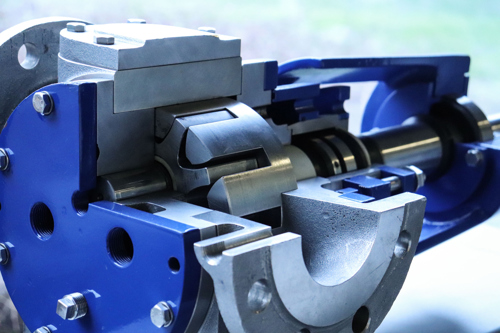
An internal gear pump is a positive displacement pump that uses two intermeshing gears to transfer liquid from the inlet to the outlet. The design consists of a driven outer gear (rotor), an internally meshing idler gear, and a crescent-shaped partition that separates the suction and discharge sides of the pump.
As the gears rotate, liquid is trapped in cavities between the gear teeth and the pump casing. The fluid is transported around the casing and discharged when the gears mesh again. Because a fixed volume of liquid is moved with each revolution, an internal gear pump provides a steady and controlled flow regardless of pressure variations within the system.
Internal gear pumps are used across a wide range of industries and are particularly well suited for handling both low- and high-viscosity liquids.
How does an internal gear pump work?
The internal gear pump working principle is based on two intermeshing gears: a driven rotor and an idler gear. As the rotor turns, it drives the idler gear, creating expanding cavities on the suction side of the pump. These cavities generate a vacuum that draws liquid into the pump chamber.
The liquid is carried between the gear teeth and the pump casing as the gears rotate. A crescent-shaped partition separates the inlet and outlet sides of the pump, preventing fluid from returning to the suction side.
As the gears come back into mesh, the cavity volume decreases, forcing the liquid out through the discharge port. Because the pump displaces a fixed volume of fluid with each revolution, it delivers a smooth and consistent flow characteristic of positive displacement pumps.
Step-by-step internal gear pump working principle
What applications are internal gear pumps used for?
Internal gear pumps are widely used to transfer, circulate, load, unload, and dose liquids across industrial processes. Their ability to handle both low- and high-viscosity fluids, combined with smooth and reliable flow characteristics, makes them suitable for a broad range of applications. Unlike many pump technologies, internal gear pumps maintain high efficiency when handling viscous products, making them a preferred choice for challenging fluids that require controlled and dependable transfer. |
|
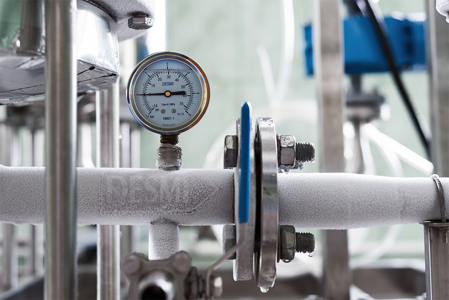
Common internal gear pump applications
Oils and lubricants
Internal gear pumps are frequently used for transferring lubricating oils, hydraulic oils, fuel oils, base oils, and additives. Their positive displacement design provides stable flow rates across a wide viscosity range.
Chemicals and industrial fluids
Many chemical processes rely on internal gear pumps to handle solvents, resins, polymers, adhesives, detergents, and specialty chemicals. Low-shear operation helps protect product quality and process consistency.
Food and beverage products
Internal gear pumps are suitable for pumping chocolate, glucose, syrups, molasses, vegetable oils, and other food-grade liquids that require gentle handling and accurate flow control.
Bitumen, asphalt, and other high-viscosity liquids
Internal gear pumps are particularly effective when handling highly viscous products. Their operating principle allows them to maintain performance and efficiency where other pump types may struggle.
Marine and energy applications
Internal gear pumps are used throughout the marine and energy sectors for fuel transfer, lubrication systems, cargo handling, and liquid circulation duties.
Why choose a ROTAN® internal gear pump?
Wide operating range
ROTAN® internal gear pumps are designed to handle both low- and high-viscosity liquids with stable and reliable performance.
- Flow rates up to 250 m³/h
- Differential pressures up to 16 bar
- Viscosities from 1 cSt to 250,000 cSt
- Temperatures from -40°C to +350°C
This flexibility allows a single pump technology to be used across many different processes and industries.
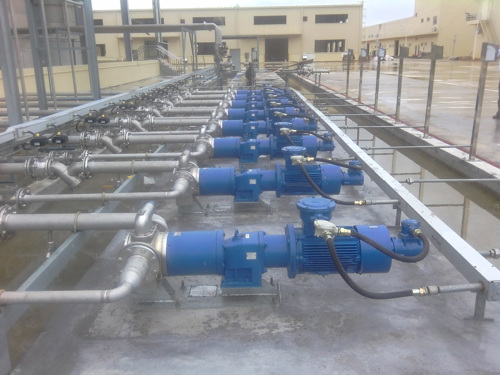
Configurations for demanding applications
Every application has different requirements for materials, sealing solutions, and operating conditions. ROTAN® internal gear pumps are available in a wide range of configurations to suit specific process needs.
Available options include:
- Cast iron, steel, and stainless steel constructions
- Multiple shaft sealing solutions
- Heating and cooling jackets
- ATEX-certified versions
- API 676-compliant configurations
- Various porting and mounting arrangements
Designed for maintenance and serviceability
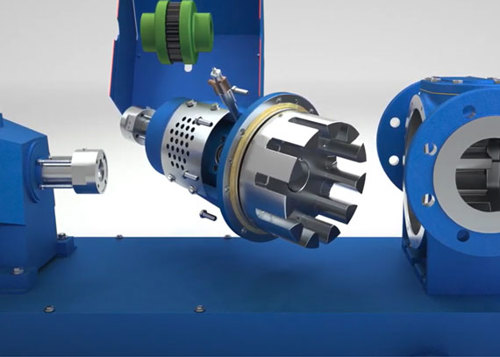
Maintenance requirements vary depending on the installation. To simplify servicing and reduce downtime, ROTAN® pumps are available with different pull-out designs.
- Back Pull-Out: design for maintenance without disturbing pipework
- Front Pull-Out: solutions for installations with limited rear access
- Top Pull-Out: designs for applications where vertical access is preferred
These service-friendly designs help reduce maintenance time and improve plant availability.
Find the right ROTAN® internal gear pump for your application
Selecting the right internal gear pump depends on factors such as viscosity, temperature, flow rate, pressure, and the properties of the liquid being handled. ROTAN® offers a wide range of internal gear pumps for applications involving oils, chemicals, food products, bitumen, fuels, polymers, and other demanding media.
Use the ROTAN® Selection Program or browse the Product Library to find the most suitable solution for your application.


Frequently asked questions about internal gear pumps
What makes internal gear pumps suitable for viscous liquids?
Internal gear pumps are particularly effective when handling viscous liquids because their positive displacement design moves a fixed volume of fluid with each revolution. As viscosity increases, volumetric efficiency often improves, allowing the pump to maintain reliable performance. This makes internal gear pumps suitable for products such as lubricants, bitumen, resins, chocolate, polymers, and heavy fuel oils.
Are internal gear pumps self-priming?
Yes. Internal gear pumps are self-priming and can generate sufficient suction to draw liquid into the pump without manual priming under normal operating conditions. For challenging suction conditions, pump selection should include an NPSH evaluation to ensure reliable operation.
Do ROTAN® internal gear pumps support bi-directional operation?
Yes. ROTAN® internal gear pumps can operate in both directions by changing the motor rotation. This makes them suitable for applications requiring product transfer in either direction or tank stripping operations. When a relief valve is installed, it must be configured according to the selected flow direction.
Are ROTAN® internal gear pumps ATEX certified?
Yes. ROTAN® internal gear pumps are available in ATEX-certified configurations for use in potentially explosive atmospheres. This makes them suitable for applications involving fuels, solvents, chemicals, and other flammable media.
How do I choose the right ROTAN® internal gear pump?
Selecting the right pump requires consideration of viscosity, temperature, flow rate, differential pressure, material compatibility, sealing requirements, and installation conditions. DESMI provides both technical support and selection tools to help identify the most suitable ROTAN® pump for a specific application.
See how companies use ROTAN® internal gear pumps


Expert articles on internal gear pumps and fluid handling


