
External Water Pump
DESMI’s external water pump solutions are engineered for reliable and energy-efficient water handling in both freshwater and saltwater aquaculture environments.
Used in recirculating aquaculture systems (RAS), fish farms and coastal installations, these centrifugal pumps provide stable flow and precise control across every stage of the water management process. Designed for dry mounting outside tanks or ponds, external water pumps offer easy access for inspection and maintenance while ensuring continuous, high-performance operation in intensive aquaculture setups.
In modern aquaculture, maintaining stable water circulation and quality is essential to fish health and system efficiency. External water pumps enable consistent inflow, outflow and recirculation within tanks and ponds, supporting biological filtration, aeration and temperature regulation. Unlike submersible units, external centrifugal pumps are mounted above water, allowing maintenance without draining large volumes or disrupting production. For RAS facilities, they are a vital component in closed-loop systems that reuse over 95% of water while supporting precise oxygen and waste control. For further insight into pump options designed for aquaculture systems, explore DESMI’s high-flow, low-pressure pumps for aquaculture.

Applications in aquaculture and marine environments
DESMI’s external water pumps play a versatile role across a wide range of aquaculture and water management environments:
-
Freshwater hatcheries and grow-out ponds - for intake, drainage and circulation.
-
Saltwater and brackish aquaculture systems - including coastal fish farms, shrimp ponds and seawater tanks.
-
RAS aquaculture installations - to maintain continuous water recirculation, filter integration and nutrient flow.
-
Auxiliary processes - such as UV sterilisation, aeration and temperature control for maintaining optimal living conditions.
The pumps are also used in water exchange and treatment applications, supporting environmental water quality in marine research centres and coastal management systems. Many of these projects feature DESMI’s pump solutions for aquaculture applications implemented across global facilities.
Key benefits: efficiency, reliability and easy maintenance
DESMI’s external water pumps deliver a combination of mechanical reliability and operational efficiency that reduces both energy consumption and total cost of ownership. Key advantages include:
-
High hydraulic efficiency, ensuring superior flow with low energy input.
-
Low NPSH values to minimise cavitation risk and extend pump life.
-
Simplified maintenance through spacer coupling options and external accessibility.
-
Versatile installation suitable for freshwater, brackish or saltwater systems.
-
Reduced downtime due to robust shaft design and service-friendly construction.
These features make DESMI pumps a cost-effective choice for operators focused on sustainable, round-the-clock aquaculture production.
Based on proven centrifugal designs, DESMI’s external water pumps are available in vertical or horizontal configurations and support flow rates up to 2000 m³/h (8800 US gpm) with heads up to 195 m. The design incorporates dynamically balanced impellers with advanced double-curved blades for efficient performance and low vibration.
Material options include cast iron, ductile iron, NiAlBz and Super Duplex stainless steel for corrosion resistance in saltwater or abrasive media. Mechanical shaft seals are single-acting, available with balanced designs for temperatures above 120°C. Pumps can integrate easily with frequency drives (VFDs) and auxiliary technologies such as DESMI AquaShield UV systems to maintain hygienic water conditions and biological control.
Additional features include spacer-coupled drives for rapid service, replaceable wear rings and optional inducers to operate under lower NPSHa conditions. Units can be supplied in designs tested to meet relevant industry and marine classification standards.
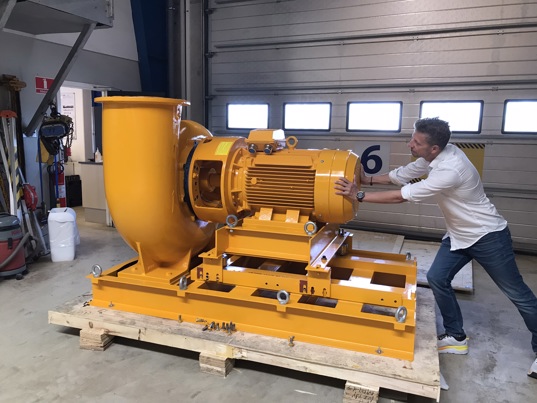
DESMI external water pumps can be supplied in accordance with international marine and industrial standards, including designs tested to ISO and marine class requirements such as ABS or DNV when specified. Their energy-optimised hydraulic design contributes to significant CO₂ reduction throughout system operation.
By supporting >95% water reuse in RAS systems, the pumps help fish farmers minimise discharge, reduce chemical use and strengthen environmental compliance. All designs are developed according to DESMI’s sustainability principles, ensuring long service life, low lifecycle cost and minimal environmental footprint.

FAQ: External water pumps
What are external water pumps?
External water pumps are dry-mounted centrifugal pumps placed outside tanks or ponds. They are used for intake, circulation and discharge operations in aquaculture and water management systems.
How do external pumps differ from submersible pumps?
External pumps are installed above the water level, making them easier to access and maintain without draining tanks. Submersible pumps, by contrast, are submerged and require more effort and downtime for servicing.
Why use external pumps in aquaculture?
They provide precise control over water movement, helping to maintain consistent flow, oxygen levels and temperature. They also enable efficient pond management and improved biosecurity through external accessibility.
How do external pumps improve system efficiency?
By facilitating high water recirculation rates - up to 95% in RAS - they reduce the need for water exchange, cut energy consumption and stabilise key parameters for fish health and growth.
How do I maintain external water pumps?
Inspect regularly for leaks, noise and vibration; clean strainers and filters; lubricate bearings according to schedule; check seals and impellers quarterly; and follow DESMI’s maintenance manual for detailed requirements and safety procedures.
Proven references from global aquaculture projects
DESMI pumps are operating reliably in aquaculture installations around the world - from Scandinavian RAS facilities producing salmon smolt to coastal shrimp farms in Southeast Asia and large-scale water management schemes supporting environmental remediation. Each project demonstrates consistent hydraulic performance, long service intervals and measurable reductions in operational energy use.


