
Comparing CIP and Mechanical Wipers
Effective cleaning is essential for maintaining UV performance, system reliability, and operational safety.
CIP and mechanical wipers offer two different approaches to cleaning industrial UV systems, with distinct considerations related to maintenance, downtime, automation, cleaning effectiveness, and long-term operating costs.
Mechanical wipers provide a straightforward physical cleaning method and generally require a lower initial investment. CIP uses a closed-loop cleaning process to remove minerals, sediments, and other deposits without dismantling the UV unit.
Understanding the differences between these two methods can help you select the cleaning system that best supports your operational requirements.
Quality
 |
Over time, the mechanical brushes of the Mechanical Wipers can wear out and require replacement, in addition to UV lamp maintenance, which causes system downtime. There is a risk that the mechanical brushes themselves can damage the UV lamps or other system components if not properly designed and maintained. |
 |
CIP reduces the need for manual labor and maintenance. CIP not only contribute to the reduction of manual intervention but also offer detailed records of maintenance cycles, simplifying compliance with regulatory standards and facilitating a comprehensive demonstration of adherence. |
|
Mechanical Wipers are only theoretically able to clean during an operation, as they will partially block the UV-Lamps and many UV-Unit designs rely on the wiper plates for flow-guidance. To ensure correct UV-Dose the wiping should be done when the UV-Unit is shut-off. We experience that these systems require more maintenance, and to maintain these systems the complete units will have to be decommissioned and taken apart to service. |
|
To perform a thorough CIP operation the UV-Unit should be shut off, so the Citric acid doesn’t become diluted and allows for a separate recirculation circuit. The actual time needed for this operation may be as little as 20 minutes! There are no mechanical parts inside the UV-Unit, only external circulation and dosing pumps may require maintenance, which can be done without interrupting the operation of the UV-Unit. |
|
Mechanical Wipers are generally more affordable upfront. They are simpler to design, install, and maintain, which can be beneficial for applications with limited technical expertise available. |
|
CIP may have a higher initial investment in CIP infrastructure. However, the initial investment can easily be recovered due to the low OPEX cost and maintenance. |

Capability
|
Mechanical Wipers lack the automation and monitoring capabilities of CIP systems, making them less suitable for highly automated processes. They typically consume less energy than the full CIP cleaning process. |
|
CIP reduces the need for manual labor and maintenance. Automatic CIP dosing units are available for even more automation. CIP systems can provide detailed records of cleaning cycles, making it easier to meet regulatory requirements and demonstrate compliance. |
|
The effectiveness of cleaning Mechanical Wipers may depend on the frequency and diligence of manual maintenance, introducing the possibility of human error. Depending on design and positioning, there can be variations in cleaning effectiveness across all UV lamps, potentially leading to uneven disinfectioncleaning process. |
|
CIP systems ensure a consistent and thorough cleaning process, leaving little room for human error. This contributes to reliable disinfection performance. |
|
Mechanical brush wipers typically do not require the use of additional cleaning chemicals. This can be an advantage in applications where chemical usage needs to be minimized. They typically only remove loose material which has settled on the lamps, but don’t thoroughly remove minerals and other materials which have adhesion. Scraper rings are often made from soft materials which will quickly wear out, if they were hard materials, they would likely damage the lamp-sleeve surface.
|
|
In applications where manual cleaning poses safety risks (e.g., handling hazardous materials), CIP systems can help mitigate these dangers. CIP will lower the pH to a level which loosens the minerals and sediments in depth, allowing the water flow to remove the material DESMI, recognizing the importance of safety, employs citric acid for CIP cleaning—a substance known for its safety attributes, approved by the FDA, and deemed suitable for both human and animal consumption. |
Mechanical wipers are commonly used to remove deposits and contamination from industrial UV systems through physical cleaning components.
During DESMI testing, several challenges related to wear, leakage, and debris buildup were observed — all factors that can impact system reliability and UV performance.
This section presents key findings from DESMI’s testing of mechanical wiper solutions in aquaculture applications.
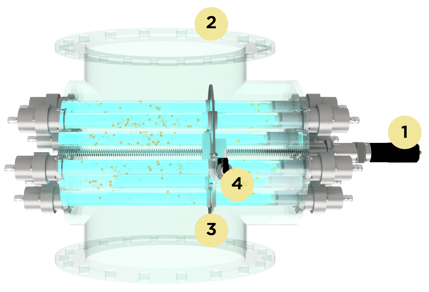
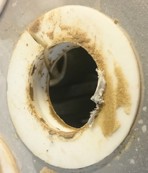
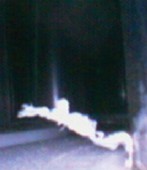
1. Some objects were caught between a scraper ring and a tube. It is material from the Teflon ring, which has somehow worn off the ring.
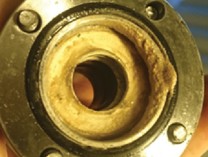
3. After removing the hub, a lot of debris/sand was discovered which is believed to have interfered with the sealing capabilities of the “VR-Seal.” Regarding UV-T measurements as W/m2, they seemed to have fallen to a lower level where almost no dimming was possible/allowed.
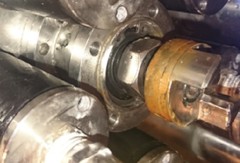
2. When the servo was removed, it was clear that there was water leakage.
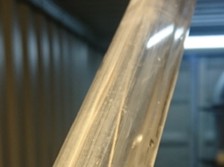
4. On the pulled-out quartz tube for the Mechanical Wipers, there was a milky white layer on the surface. Rings can be seen along its length, signs of the plate “jumping” across the tube.