Why Electric Motor Sizing Matters for Frequency Converter Operation
By Simon Anthes, Senior Application Manager at DESMI
Variable frequency drives (VFDs) are now standard in modern aquaculture facilities.
They provide:
- flow control
- energy savings
- smoother system operation
However, many systems overlook a critical detail:
the electric motor must be properly sized for VFD duty.
The Three Key Parameters
When selecting motors for pump systems, three electrical characteristics must be understood.
1. Current
Motor current determines:
- cable sizing
- thermal loading
- inverter requirements
Under VFD operation, motors may experience higher RMS current due to harmonics.
(RMS – Root Mean Square – is the effective current value that determines how much heating occurs in the motor windings.)
2. Power Factor
Power factor describes how effectively electrical power is converted into mechanical power.
A poor power factor leads to:
- increased current draw
- higher electrical losses
VFDs help improve system control but introduce harmonic distortion, which affects electrical efficiency.
3. Torque
Pump loads are governed by the affinity laws.
Torque is proportional to the square of speed for centrifugal pumps.
This means:
- high torque is required during startup
- stable torque is needed across the operating range
Motors must be sized to handle these conditions without overheating.
Graphic: Pump Affinity Laws
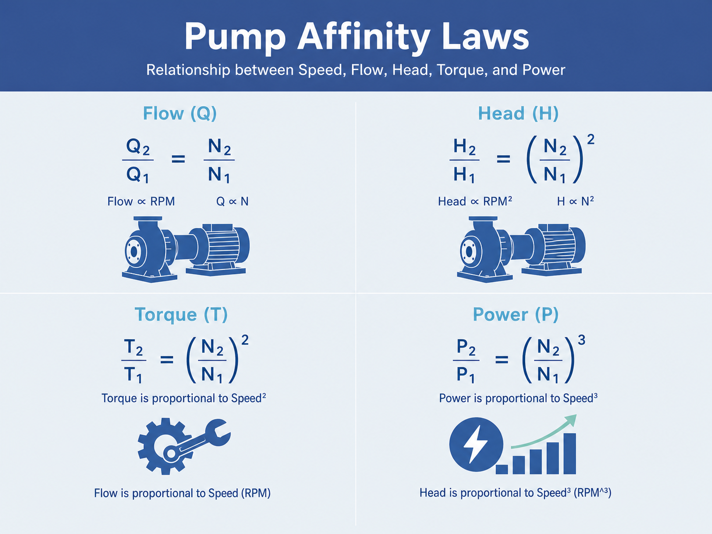
Centrifugal Pump Affinity Laws (AI-generated image)
Small speed increases can dramatically increase power demand.
Why Undersized Motors Cause Problems
If the motor is undersized:
• overheating may occur • inverter current limits may trip • system reliability decreases
Correct sizing ensures the motor can handle:
- continuous duty
- VFD switching stresses
- variable load conditions
Best Practice
For VFD-driven pump systems:
- select motors designed for inverter duty
- verify torque capability across speed range
- ensure sufficient thermal margin
Takeaway
Pumps, hydraulics, and electrical systems are deeply interconnected.
Reliable aquaculture infrastructure requires engineers to understand both fluid mechanics and electrical behaviour.
Getting the motor sizing right ensures the pumping system performs reliably for years.


