


Simon Anthes
Application Manager AquaCulture
Phone: +45 4129 4898
By Simon Anthes, Senior Application Manager at DESMI
Centrifugal pumps are often blamed when systems underperform. In reality, the pump is rarely the problem. The piping connected to it is.
In land-based aquaculture facilities - particularly large RAS systems - poor inlet piping design can reduce pump performance by 20–40%, increase energy consumption, and shorten equipment lifetime.
That is why the European standard CEN 13932 exists. It defines how piping systems should be arranged around centrifugal pumps to ensure stable hydraulic conditions.
Why This Matters in Aquaculture
Water circulation is the backbone of a land-based farm. Every subsystem relies on stable flow:
If the pump operates under unstable hydraulic conditions, it can lead to:
In systems circulating thousands of cubic meters per hour, even small inefficiencies become expensive.
The Core Principle: Stable Flow Into the Pump
Centrifugal pumps are designed to receive uniform, non-turbulent flow at the impeller eye.
Disturbed inlet flow causes:
This reduces efficiency and increases wear.
CEN 13932 therefore recommends proper inlet piping arrangements.
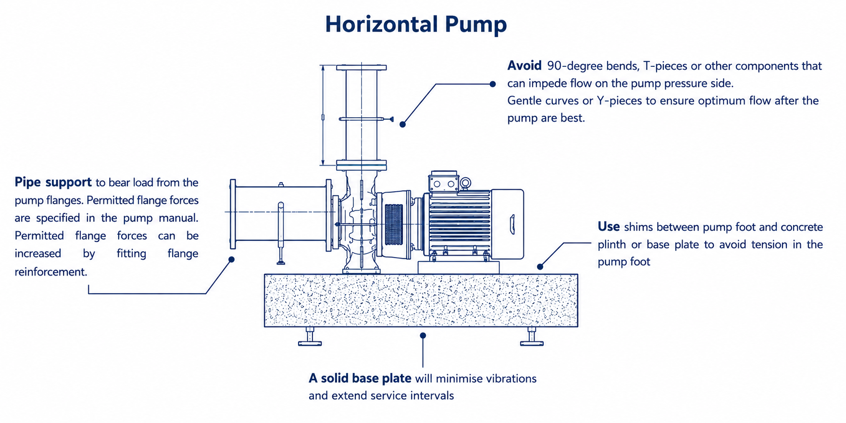
Optimum pump installation
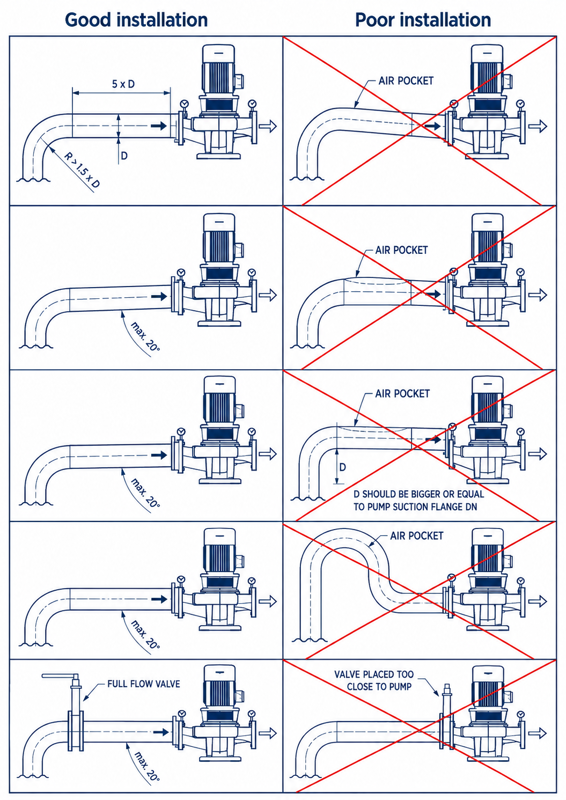
Recommended design of pipes on suction side (AI-generated images)
Key Recommendations From CEN 13932
1. Provide sufficient straight pipe before the pump
A common recommendation is:
5–10 pipe diameters of straight pipe
before the suction flange.
This stabilizes velocity distribution.
2. Avoid elbows directly at the pump inlet
An elbow immediately before the pump introduces swirl and asymmetric flow, which the impeller is not designed to handle.
3. Avoid sudden diameter changes
Reducers should be eccentric reducers with flat top orientation to prevent air pockets; however concentric reducers are fine for vertical inlets.
4. Prevent air accumulation
Entrained air dramatically increases cavitation risk.
Design should avoid:
The Hidden Cost of Bad Piping
Many pumping problems attributed to pump manufacturers are actually caused by:
Fixing these can often deliver double-digit energy savings without changing the pump.
In an industry where energy is one of the largest operating costs, this matters.
Takeaway
A centrifugal pump cannot perform better than the hydraulic conditions it receives.
Following CEN 13932 ensures:
And in aquaculture systems operating 24/7, those gains accumulate quickly.
Application Manager AquaCulture
Phone: +45 4129 4898