


Simon Anthes
Application Manager AquaCulture
Phone: +45 4129 4898
By Simon Anthes, Senior Application Manager at DESMI
Modern aquaculture facilities increasingly operate pumps using frenquency converters (VFDs)
This allows flexible flow control, but it also introduces a new challenge:
The pump may operate far away from its Best Efficiency Point (BEP)
The Best Efficiency Point is the operating condition where a pump converts energy most efficiently.
At this point:
Static vs Dynamic Head
To understand where the duty point occurs, we must distinguish between two components.
Static head is the height difference between suction and discharge levels.
It does not change with flow.
Example:
Static head = 1.5 m
Dynamic head represents friction losses in the piping system.
These increase with flow rate.
Factors include:
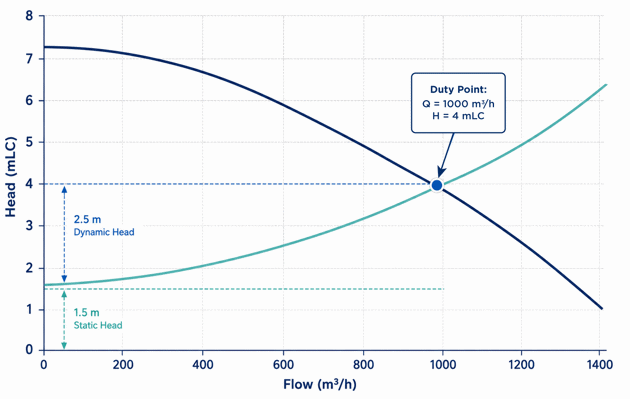
Example of Static & Dynamic Head, plus a duty point intersecting the system curve and the pump curve (AI-generated image)
When pump speed changes, the pump curve shifts.
This means the operating point moves along the system curve.
If not properly designed, the pump can operate far away from BEP.
Most pump manufacturers recommend operating between:
70% – 120% of BEP flow
Outside this range, problems may occur:
• vibration • recirculation • reduced efficiency • mechanical stress
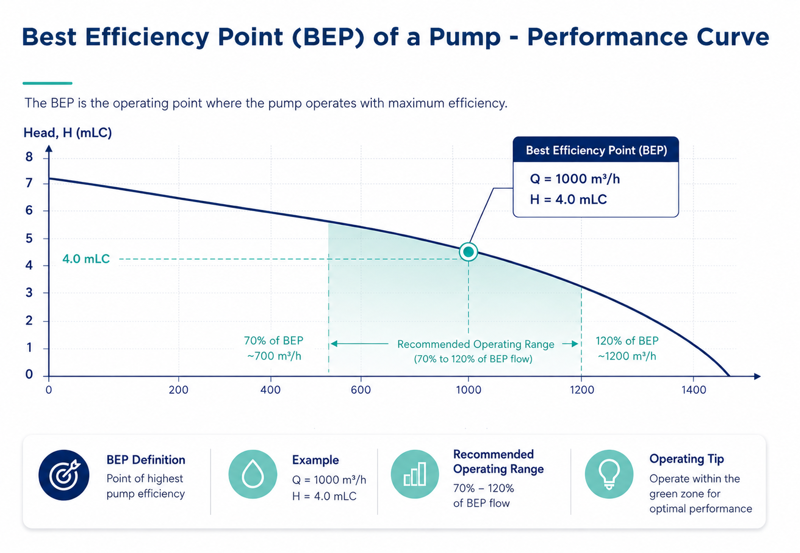
Example with DESMI NSLH400-390 pump (AI-generated image)
In RAS systems, flow requirements change depending on:
VFDs allow flexible operation, but the system must be designed so that all expected operating points stay near BEP.
Pump efficiency is not determined only by the pump itself.
It is determined by how the system curve interacts with the pump curve across the full operating range.
Proper hydraulic design ensures pumps operate near their BEP even when speed changes.
Application Manager AquaCulture
Phone: +45 4129 4898