


Simon Anthes
Application Manager AquaCulture
Phone: +45 4129 4898
By Simon Anthes, Senior Application Manager at DESMI
When sizing centrifugal pumps, engineers often focus on flow and head.
However, one parameter is equally critical:
Net Positive Suction Head (NPSH).
Ignoring it can lead to one of the most destructive pump phenomena:
Cavitation.
Cavitation occurs when local pressure drops below the vapor pressure of water.
This causes vapor bubbles to form and collapse violently inside the pump.
The results include:
Understanding NPSH requires distinguishing between two values.
This describes how much suction pressure the system can provide.
It depends on:
This is how much suction pressure the pump itself requires to operate without excessive cavitation.
It is determined by the pump design and provided by the manufacturer.
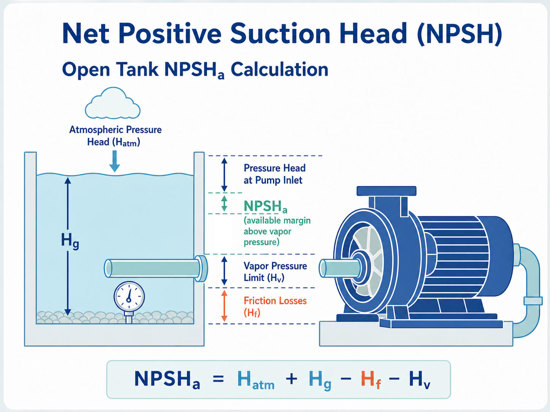
NPSHa (AI-generated image)
The Safety Rule
For reliable operation:
NPSHa must always be greater than NPSHr
Typically, pump manufacturers have a minimum safety margin. Some recommend 0.5 m most would prefer a minimum margin of 1 m.
If the application is noise critical then a larger margin is preferred, e.g. 1.3 to 2.0 times the NPSHr of the pump at the given duty point.
Why This Is Critical in Aquaculture
Generally NPSH is not an issue in aquaculture RAS, however water intakes need careful consideration due to, e.g. varying tide levels:
Both of these reduce available NPSH.
This is why intake design, piping design, and pump selection must be considered together.
Practical Engineering Advice
To increase NPSHa:
• reduce suction pipe losses • increase water level above the pump • increase pipe diameter
These changes can dramatically reduce cavitation risk along with reduced pump speed.
Takeaway
Ignoring NPSH during pump selection can destroy pumps long before their expected lifetime.
Understanding the relationship between NPSHa and NPSHr is essential for reliable system design.
Application Manager AquaCulture
Phone: +45 4129 4898