Designing Water Intakes Correctly
By Simon Anthes, Senior Application Manager at DESMI
Water intake design is one of the most underestimated parts of aquaculture infrastructure.
Whether the water source is sea, fjord, lake, or groundwater wells, the intake system determines:
- pump reliability
- energy efficiency
- fish safety
- biosecurity
The European standard CEN 13930 provides guidance on how intake systems should be designed to ensure stable and safe hydraulic conditions.
The Purpose of an Intake System
A properly designed intake must achieve three things simultaneously:
- Deliver uniform flow to the pumps
- Prevent debris and marine life ingress
- Minimize hydraulic losses
If any of these fail, pumps operate under unstable conditions.
Common Intake Problems
In poorly designed systems we often see:
- vortex formation
- uneven flow distribution
- air entrainment
- debris accumulation
These issues can lead to:
• cavitation • pump vibration • reduced capacity • increased maintenance
Key Design Considerations
CEN 13930 highlights several important aspects.
1. Adequate Submergence
If the intake is too close to the water surface, vortices can form and pull air into the pump system.
This is one of the most common causes of cavitation in intake pumps.
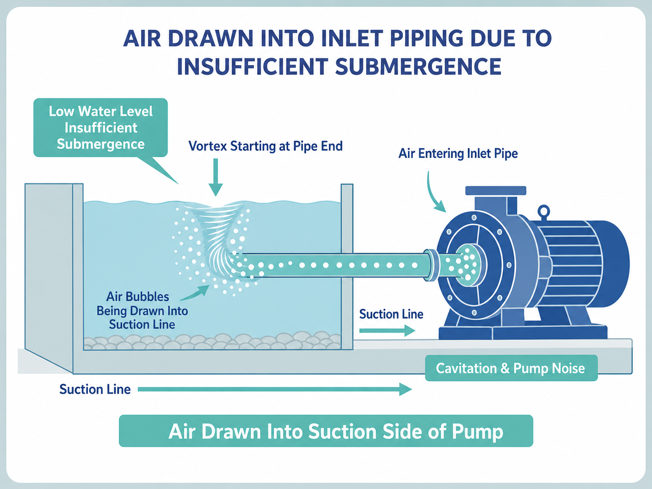
Illustration of air being drawn into pump through vortex (AI-generated image)
2. Proper Intake Velocity
Velocity should be kept low enough to:
- avoid entraining fish or debris
- minimize hydraulic losses
Typical intake velocities are designed around 0.3 m/s in the approach channel accelerating gradually towards the pump.
3. Flow Distribution
Multiple pumps should not compete for water.
Intake geometry should ensure uniform velocity distribution across all pumps.
4. Debris Protection
Screens and coarse filtration should be positioned to:
- prevent clogging
- maintain low head loss
This is particularly important in coastal aquaculture sites where algae and marine growth can be significant.
Why This Matters for RAS and Flow-Through Systems
Stable intake design improves:
• pump reliability • energy consumption • system uptime • maintenance intervals
In large aquaculture facilities operating continuously, even small improvements in intake hydraulics can significantly reduce operational risk.
Takeaway
The intake system is the first hydraulic component in the entire pumping chain.
If it is poorly designed, everything downstream suffers.
Following CEN 13930 ensures pumps receive the stable hydraulic conditions they were designed for.
